By Dr. Jonathan W. Lartigue
September, 2026
“A nation which is refraining from research obviously cannot match the gains of a nation conducting research.”
This quote might immediately seem relevant to you amid today’s debate on slowing the advancement of AI research. Indeed, President Trump recently stated “The greatest threat of all is to forfeit the race.”1 But the original quotation is not about AI, and it’s not even recent. Replace the word “research” with “tests”, and you have John F. Kennedy’s 1962 quote regarding nuclear testing.2
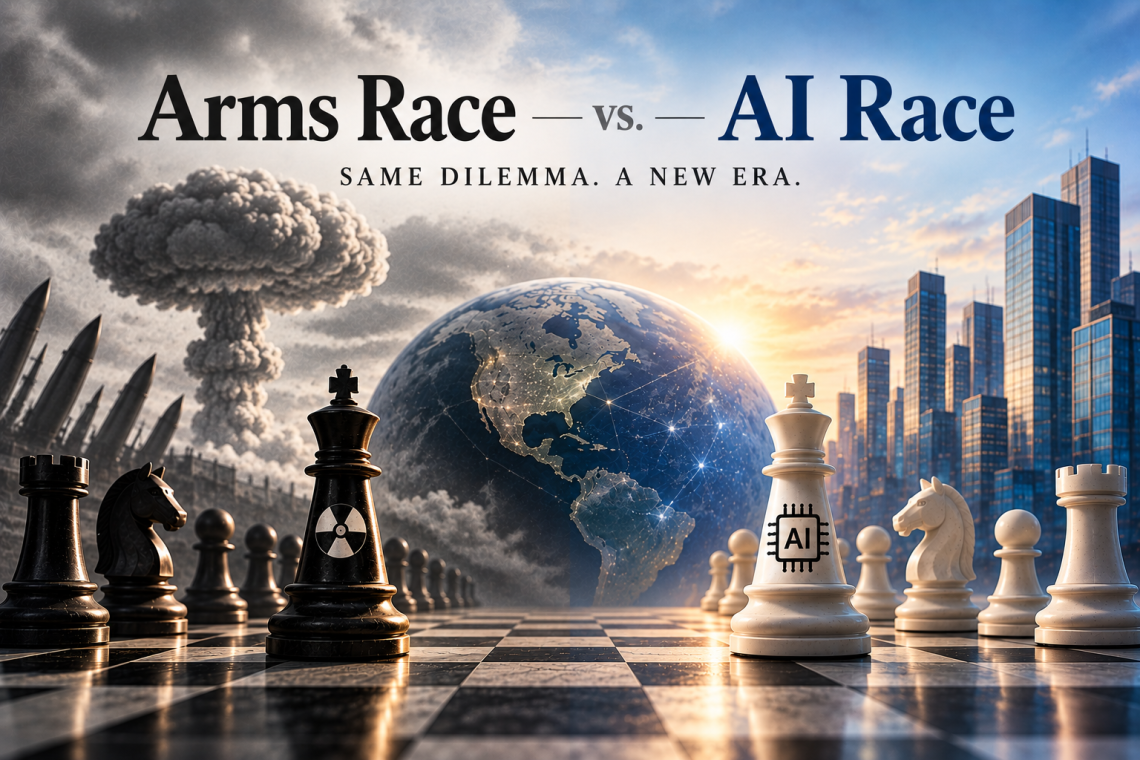
Although nuclear weapons and artificial intelligence differ profoundly, the parallels between the nuclear race and today’s competition in AI are striking.
During the nuclear arms race, continued development of nuclear weapons was pursued as a means of deterrence, maintaining a credible retaliatory capability that contributed to the strategic condition known by the macabre acronym Mutually Assured Destruction (MAD). Then, continued development of nuclear weapons and the increase of the U.S. arsenal was meant to deter the destruction of the U.S. or its allies in a deliberate attack by the Soviet Union through a credible retaliatory capability.
But deterrence is an equally apt term for the AI race. Today, continued AI development is necessary for a sort of competitive deterrence – preventing strategic competitors from acquiring a decisive economic or technological advantage that can result in the economic ruin of the United States by its adversaries.
In 1970, a National Intelligence Estimate stated that “The weapons competition nowadays is largely a technological race; each side is impelled to press forward its research and development lest it be left behind.”5
Additionally, Ronald Reagan said in 1985 that the U.S. had “no alternative but to compete” in the arms race, and government leaders are saying the same about the AI race today.3 The strategic dilemma is is remarkably similar: we cannot slow our development of AI and be assured that our adversaries will follow suit until mechanisms exist to constrain our compettitors as well as ourselves.
Defense Secretary Robert McNamara said in 1967 “It is precisely this action-reaction phenomenon that fuels an arms race,” which is true whether nuclear or AI.6
An historical example of what might happen should the U.S. unilaterally slow the pace of AI development can be found in the events between 1958 and 1962 when Kennedy, who was not an enthusiastic supporter of an unconstrained arms race, wished to end nuclear testing:
- The United States wanted nuclear testing stopped, and voluntarily stopped such testing.
- The Soviet Union agreed to stop, but secretly prepared further tests.
- The Soviet Union resumed testing and obtained useful technological information.
- The U.S. then faced a choice: continue exercising unilateral restraint, or resume technological research to avoid falling behind.
Obviously, Kennedy reluctantly chose the latter option, while continuing diplomatic efforts for a reciprocal agreement. The lesson of 1962 is not that restraint was undesirable, but that unilateral restraint is not equivalent to mutual restraint.
Dr. Henry Kissinger, one of the strategists of nuclear deterrence and advisor to a dozen U.S. presidents, lived long enough to see the early releases of generative AI tools that have since exploded in popularity. He foresaw a new type of arms race and described AI as the “biggest challenge of our times.”4
Kissinger went further: “Never in history has one great power fearing that a competitor might apply a new technology to threaten its survival and security forgone developing that technology for itself.”7
If Kissinger were alive, he would agree that it may be highly desirable for the major AI powers collectively to slow or constrain particular forms of development. But he would also point out that the United States cannot safely impose constraints on itself that its strategic competitors do not share.
The amount of money being spent, both in the U.S. and abroad, in developing AI technology assures that neither the corporations nor the governments pursuing more advanced technology can tap on the brakes. The consequences to the economy, both in short term market declines and long term competitive advantage, are too great.
Another consideration is that command and control of nuclear weapons rests with governments and key leaders. It was comparatively easier to reach nuclear arms testing and stockpile limitation agreements, because control of the weapons was tight. AI is not controlled by any single government, but instead hundreds of companies and research institutions throughout the world. The possibility of reaching a consensus on AI limitations among all of these is vanishingly small.
Absent credible mechanisms for reciprocal restraint, the incentives facing governments and corporations strongly favor continued AI development—and drive further acceleration.
The nuclear age therefore leaves us with two warnings. Kennedy demonstrated the danger of unilateral restraint when a competitor continues to advance. McNamara demonstrated the danger of the action-reaction cycle that results when each side responds to every advance of the other. The challenge of AI policy is to avoid both: preserving American technological capability without allowing competitive pressure to make meaningful restraint impossible.
Dr. Jonathan W. Lartigue is an associate director for business and program management in the aerospace and defense industry. He is an engineering process expert and Advanced SAFe Practice Consultant with more than 17 years of experience in training and leading agile teams. He holds a master’s degree in software engineering and a PhD in computer science and software engineering from Auburn University. He also holds a degree in journalism, is a former reporter and editor, and writes frequently about artificial intelligence, project management, tech history, and mentoring.
© Copyright 2026. All rights reserved.
[1] Donald J. Trump, “Remarks on Signing Executive Orders at the Artificial Intelligence Summit,” July 23, 2025.
[2] John F. Kennedy, “Nuclear Testing and Disarmament”, Television address, March 2, 1962.
[3] Ronald Reagan, “Address to a Special Session of the European Parliament in Strasbourg, France”, May 8, 1985.
[4] Thibault Spirlet, “AI Is the ‘Biggest Challenge of Our Times’ and Humanity Could Be Replaced by Machines in 5 Years, Henry Kissinger Says,” Business Insider, October 24, 2023.
[5] NIE 11-8-70, “Soviet Forces for Intercontinental Attack”, November 24, 1970, U.S. Department of State.
[6] Robert F. McNamara, “The Dynamics of Nuclear Strategy”, September 18, 1967.
[7] Henry A. Kissinger and Graham Allison, “The Path to AI Arms Control,” Foreign Affairs, October 13, 2023.
Artificial Intelligence was utilized in generating the illustration accompanying this article. View our AI Usage Policy.


Nice article, and nice website. Looks like you’re doing okay these days.
How do you feel about my posting the link to this article (and perhaps others) on Facebook?
Is there a way to get notified, perhaps via email, when you post new content?
Finally, would you care to share your email with me?
Please feel free to post a link to this article on this site. I have shared my contact information with you privately in an email.